
Building the Infrastructure Series: Chicago’s Open Mics Are Developing the City’s Next Generation of Artists
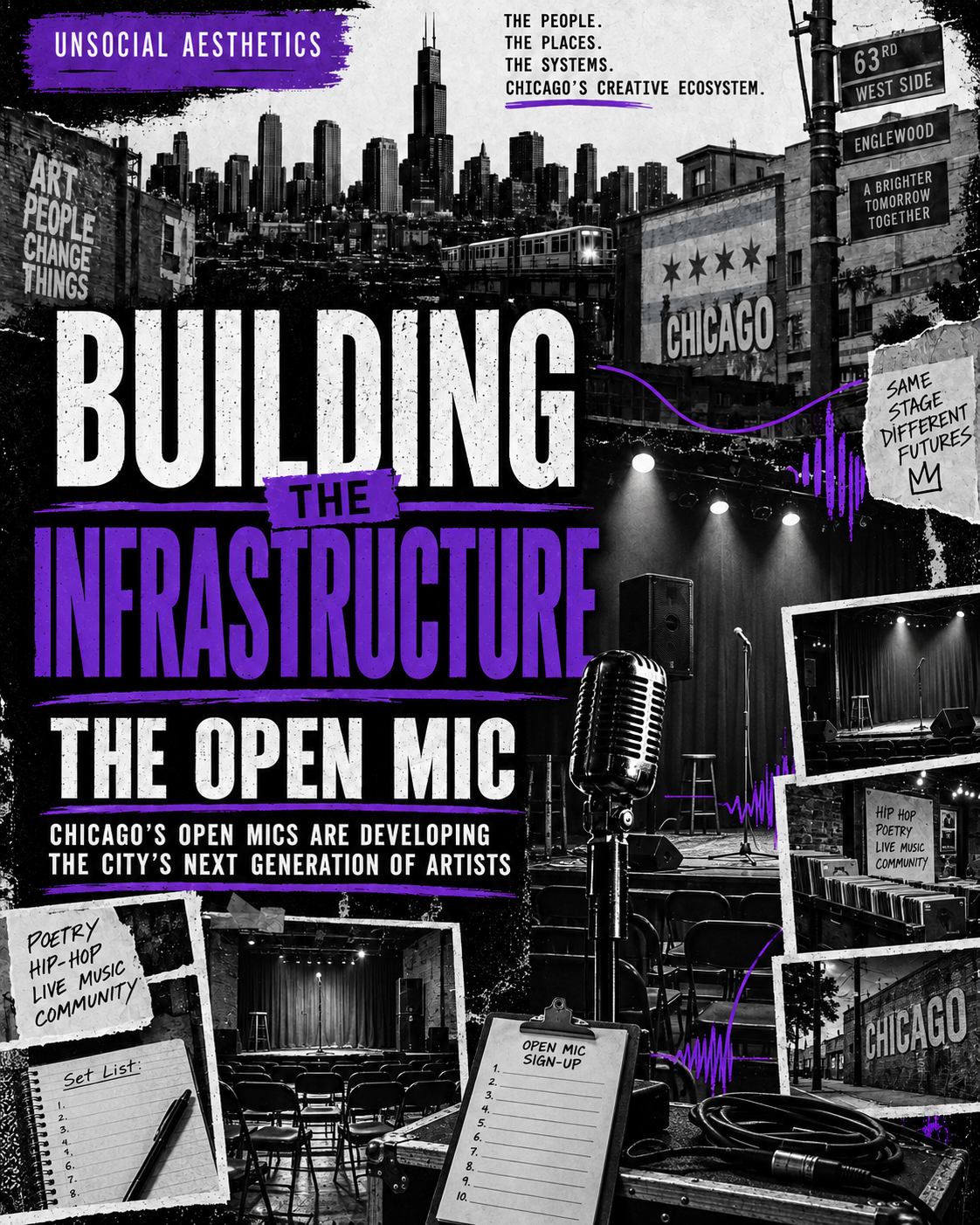
For decades, Chicago’s music scene has existed across multiple worlds. An artist can build momentum in one community, perform consistently, develop an audience, and still remain almost completely unknown to another side of the city. Each community has its own platforms, curators, audiences, relationships, and ideas about what deserves recognition. However, there is one piece of Chicago’s creative infrastructure that continues to connect those different worlds, the open mic. Chicago has never suffered from a lack of artists willing to perform. The real question has always been whether those artists have enough spaces where they can develop before the industry expects them to already be successful. For generations, open mics have helped answer that question..
More Than an Opportunity to Perform
The open mic has been extremely important to the foundation of Chicago’s music ecosystem, scene, industry, and the larger infrastructure being created around all three. Before an artist receives a major booking, press coverage, management, or industry attention, the open mic is often where they first learn how to stand in front of a room and trust their own voice. It is where artists test unfinished material. It is where they learn how to read a crowd. It is where they develop confidence, stage presence, discipline, and community. Most importantly, it is one of the few spaces where an artist does not always need a large following, industry connection, or cosign before being allowed to perform. The open mic gives artists an opportunity to be recognized while they are still becoming..
The Organizations That Built the Foundation
Organizations such as Kuumba Lynx, LYRIC, and many others have spent years creating opportunities for emerging artists throughout Chicago. Some of these organizations are nonprofits. Others operate independently or through for profit models. They may not all follow the same blueprint, but their work has helped artists sharpen their talents, build relationships, and become more comfortable taking up space. That work should not be treated as separate from the music industry. It is artist development. It is community organizing. It is cultural preservation. It is infrastructure. These organizations have created rooms where artists can meet collaborators, receive feedback, find mentorship, and discover opportunities that may not have reached them anywhere else. Many of Chicago’s most important creatives began their journeys in rooms exactly like these, performing before small audiences that recognized their potential before the larger industry ever knew their names..
Independent Curators Are Building Their Own Systems
The open mic infrastructure of Chicago is not only being built by established organizations. Individual curators and community leaders continue to create their own platforms throughout the city. Chairman Fred Hampton Jr. is one example of someone who has consistently created space for artists to speak, perform, and introduce their work to the community. Whether the opportunity exists inside a traditional venue, a neighborhood gathering, or another community centered environment, the goal remains the same, give people a platform before someone else decides whether their voice is valuable. That type of organizing matters because Chicago artists have often had to build their own systems. When venues overlook them, they create new stages. When institutions fail to invest, they organize their own events. When the industry refuses to recognize their communities, they place microphones directly inside those communities. That is how Chicago has continued to develop artists even when the traditional industry has not provided enough resources to sustain them..
The Open Mic Is Expanding
During the last four or five years, Chicago’s open-mic scene has expanded tremendously. There are open mics created specifically for LGBTQ communities. There are events centered in neighborhoods out South and out West. There are gatherings taking place in areas that outsiders continue to stereotype through violence while ignoring the art, organizing, healing, and community already happening there. These open mics directly challenge those narratives. They demonstrate that Chicago’s neighborhoods are not culturally empty or creatively broken. They are filled with artists searching for rooms where their work can breathe without being misunderstood before it is even heard. Some open mics happen every week. Others happen every other week or once a month. Some are traditional showcases. Others include spoken-word competitions, performance challenges, workshops, or structured critique. Platforms such as the Big Kid Challenge have shown how competition can be used to create larger opportunities. Artists are able to present their work, receive honest feedback, and improve without feeling as though critique is intended to embarrass or discourage them. Each format serves a different part of the ecosystem. That variety is one of the open mic community’s greatest strengths..
Artist Development Does Not Begin With a Record Deal
When people hear the words “music infrastructure,” they often think about record labels, managers, recording studios, distributors, attorneys, publicists, and booking agencies. All of those pieces matter. But infrastructure must also include the spaces where artists learn how to become artists in public. Chicago needs more stages that welcome developing talent. It needs more curators willing to discover artists before the numbers arrive. It needs more spaces where experimentation is encouraged. It needs more constructive critique. It needs more collaboration between open-mic organizers, venues, media platforms, studios, festivals, and artist development companies. The open mic is not simply the activity that happens before the “real” show. For many artists, it is the first real show..
Community Is Still Chicago’s Greatest Resource
The strength of Chicago’s open mic culture has never depended entirely on money. It has depended on community. Hosts, DJs, poets, musicians, organizers, photographers, videographers, venue owners, and audience members all contribute to these spaces. Even the person standing in the back of the room and paying attention can help an artist believe their work deserves to continue. That community can transform one performance into a collaboration, a booking, a studio session, a friendship, or the beginning of an entire career. The people doing this work may not always receive recognition as industry builders, but that is exactly what they are. They are developing talent. They are connecting communities. They are preserving stories. They are creating opportunities where traditional systems have left gaps..
The Next Chapter
The conversation should no longer be about whether Chicago has places for emerging artists to perform. The better question is whether the city is paying enough attention to the open-mic infrastructure that already exists, and whether these spaces are receiving the investment necessary to survive. Chicago’s open mics are evolving because the artists and communities they serve are evolving. New formats are being created. Different neighborhoods are establishing their own platforms. Communities that were previously excluded are building spaces according to their own needs. The future of Chicago music will not be shaped only inside label offices, major venues, or downtown institutions. Part of that future is being developed every week inside small rooms, neighborhood organizations, community centers, bars, galleries, and temporary spaces throughout the city. The next important artist may already be performing. The next important curator may already be hosting. The next important movement may already be gathering around a microphone. Chicago has always had the talent. The open mic is one of the places where that talent learns how to become undeniable..